

Abstract
AI business context validation is the discipline of ensuring that AI systems understand your business accurately enough to recommend it. Unlike traditional search, where rankings link to static signals, AI systems dynamically assemble a version of your brand every time a user submits a query.

Traditional analytics show traffic clicks and conversions by human behavior. They don't show how AI understands your business or why it recommends a competitor instead. That gap is what AI business context validation solves: ensuring your category, use cases, differentiation, and value are correctly interpreted within AI systems before decisions are made.
Nearly three in four shoppers are using AI in their purchasing journey, relying on tools like ChatGPT to compare products and evaluate options before visiting a single website. What started in commerce is now spreading into B2B, where AI agents increasingly define which vendors make the cut.
AI Business Context Validation Explained
AI business context validation is about understanding why and how AI systems include your brand in their responses. AI systems pull from multiple sources and reconstruct meaning in real time, continuously reinterpreting your brand based on the strength and clarity of the signals available.
That fluidity is what makes it difficult to implement AI strategic visibility. When key elements of your business are unclear or underrepresented, AI systems compensate by inferring missing information or generalizing your positioning. Over time, this leads to a version of your brand that may be partially accurate but strategically misaligned, and that misalignment directly impacts whether AI agents recommend or overlook you.
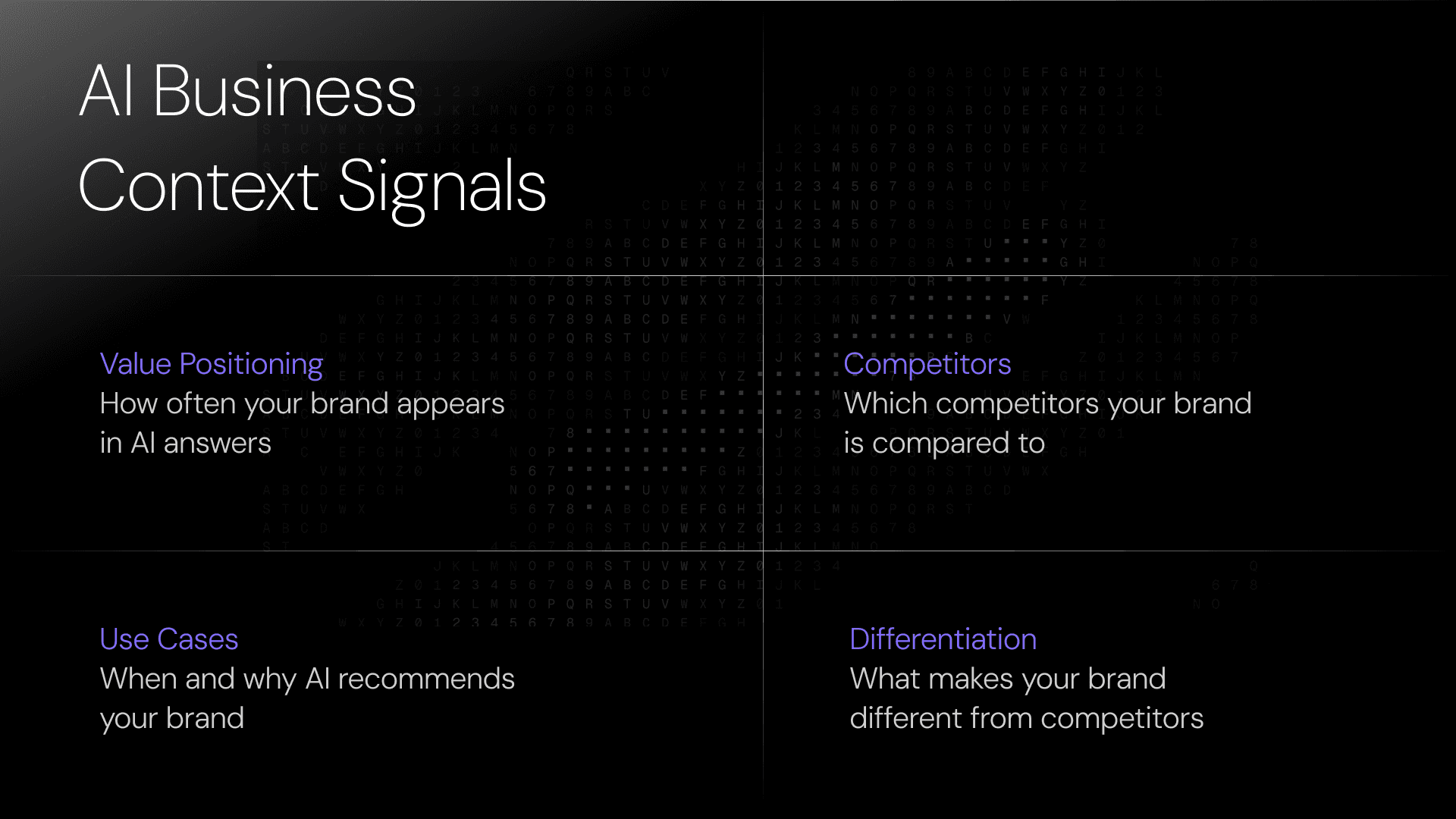
AI Business Context Signals
Business context spans the full set of signals that determine how your brand is evaluated and positioned:
Product category: how AI classifies what you are
Use cases: when and why you are considered relevant
Differentiation: what makes you distinct from alternatives
Competitors: who you are compared against in recommendations
Value positioning: how your pricing and offering are framed
Weak or inconsistent signals in any of these areas create gaps, and AI systems will fill those gaps, often in ways that favor competitors.
Visibility answers a surface-level question: Are you appearing in AI-generated answers? Context accuracy addresses the deeper issue: are you being understood correctly, and does that understanding lead to a recommendation?
A brand can appear frequently and still lose influence if it is misclassified, poorly differentiated, or positioned as a secondary option. In contrast, a brand with strong, consistent context signals can outperform competitors even with fewer mentions.
Why AI Business Context Validation Matters Now
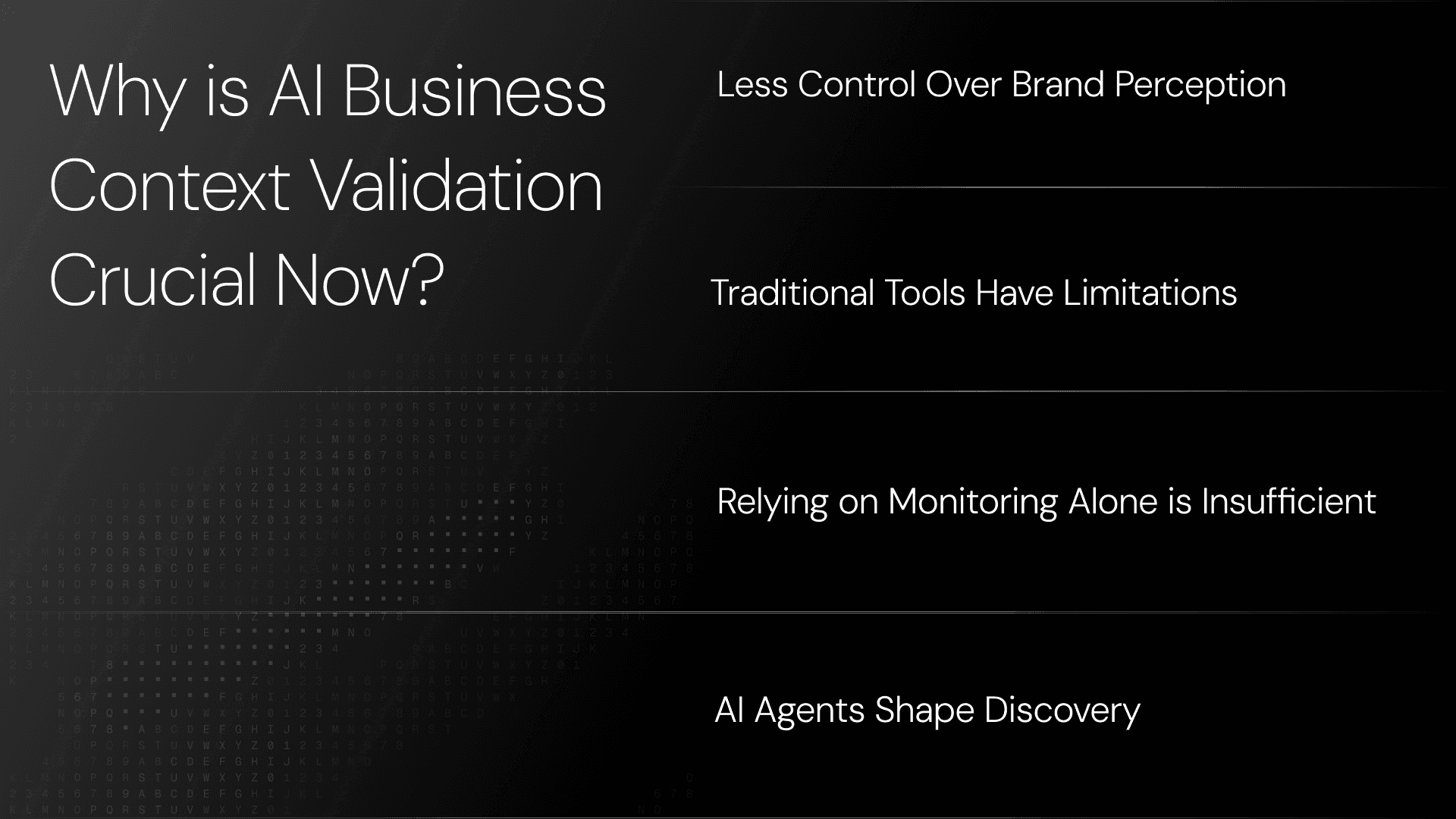
AI Agents Now Shape Discovery
Discovery now often starts with AI systems. This shift, often described as Business-to-Agent (B2A), reflects a new reality in which brands no longer communicate directly with buyers at the first touchpoint but instead do so through systems that evaluate and recommend options on their behalf.
AI agents don’t show options. They construct answers, synthesize options, compare alternatives, and deliver a shortlist that reflects their interpretation of the market. By the time a human engages, the field of consideration has already been narrowed. If your business context is incorrect at that stage, you’re already out.
There is Less Control Over Brand Perception
Without validation, AI systems will define your brand based on the signals they can access. Competitors with stronger or more consistent context will dominate key queries. AI agents may misclassify our product, associate it with secondary use cases, or exclude it from high-intent comparisons altogether. In “best” or “top” queries - where recommendations drive outcomes - even small gaps in context can determine whether you appear or disappear.
What makes this especially challenging is that these outcomes are not visible through traditional reporting. There is no ranking report explaining your absence, nor a dashboard showing how your brand was interpreted. The decision-making layer is opaque, and by the time traffic reaches your site, the outcome has already been shaped elsewhere.
Traditional Tools Have Significant Limitations
The tools most marketing teams rely on were built for a fundamentally different environment, as they were built for human behavior, not capturing agent signals. For example, Google Analytics and Google Search Console measure traffic, clicks, impressions, and site health, while SEO platforms measure rankings and keywords. GEO tools attempt to bridge this by tracking mentions in generated outputs, but they still rely on sampled prompts or simulated queries. None of these systems captures how AI interprets your brand or how it constructs recommendations.
At an enterprise level, the limitations are even more pronounced. There is no standardized reporting for AI-driven performance, no governance layer to manage changes in AI visibility, and no integration framework that connects AI-driven discovery to pipeline or revenue outcomes. Teams are left with fragmented signals that fail to reflect how AI systems and, consequently, their users, actually make decisions.
Teams Often Rely on Monitoring Alone
Many tools have emerged to track AI visibility, but visibility is a surface metric. It shows whether you appear, not whether you win. What you need is infrastructure-level measurement - a system that captures how AI agents interact with your site, what they extract, how they interpret your content, and which of those interactions connect to marketing attribution and meaningful outcomes.
Because without accurate context, your brand is effectively invisible, even when it is technically present. And in a discovery layer driven by AI, that invisibility translates directly into lost influence, missed opportunities, and measurable revenue impact.
Limy solves this through structured prompt clusters tied to your business context. Brands define their own “brand kit”: the categories, topics, competitors, and regions that matter, allowing visibility to be measured against the AI conversations most likely to influence traffic, conversions, and revenue. This level of customization reveals which prompts and sources competitors dominate and where AI-driven demand is actually forming.
5 Steps to Validate and Fix AI Business Context
Identify High-Intent Prompts That Drive Decisions
Start by mapping the prompts that sit closest to revenue, avoiding generic discovery queries like “what is X” or “how does Y work.” Instead, focus on prompts where you expect AI to recommend, compare, or shortlist options. For example:
“Best [category] for [specific use case]”
“[Product type] vs [competitor]”
“Top tools for [problem] in [industry]”
“Which solution should I choose for [goal]”
The key is to isolate prompts where a recommendation directly influences a decision. Working backward from revenue outcomes, look at your highest-converting use cases, core product categories, and key buyer scenarios, then translate those into the types of questions a buyer would ask an AI system.
You then have a focused set of prompts that represent real commercial intent, aligned with how AI now shapes your customer acquisition strategy. You can either start mapping manually and assume these prompts or use a stack like Limy that identifies this for you based on real agent signals.
Extract and Compare AI Outputs Across Those Prompts
Once you have a defined prompt set, the next step is to analyze how AI systems respond to it. Systematically review answers across major LLMs and document:
Whether your brand appears
How it is described (category, use case, positioning)
Which competitors appear alongside you
Where you are ranked or prioritized in the answer
The critical part here is not just presence, but language. How AI describes your brand reveals how it understands it. For example, if your product is consistently framed under a secondary use case or grouped with lower-tier alternatives, that signals a context issue, even if you’re being mentioned.
Map Context Gaps and Misalignment
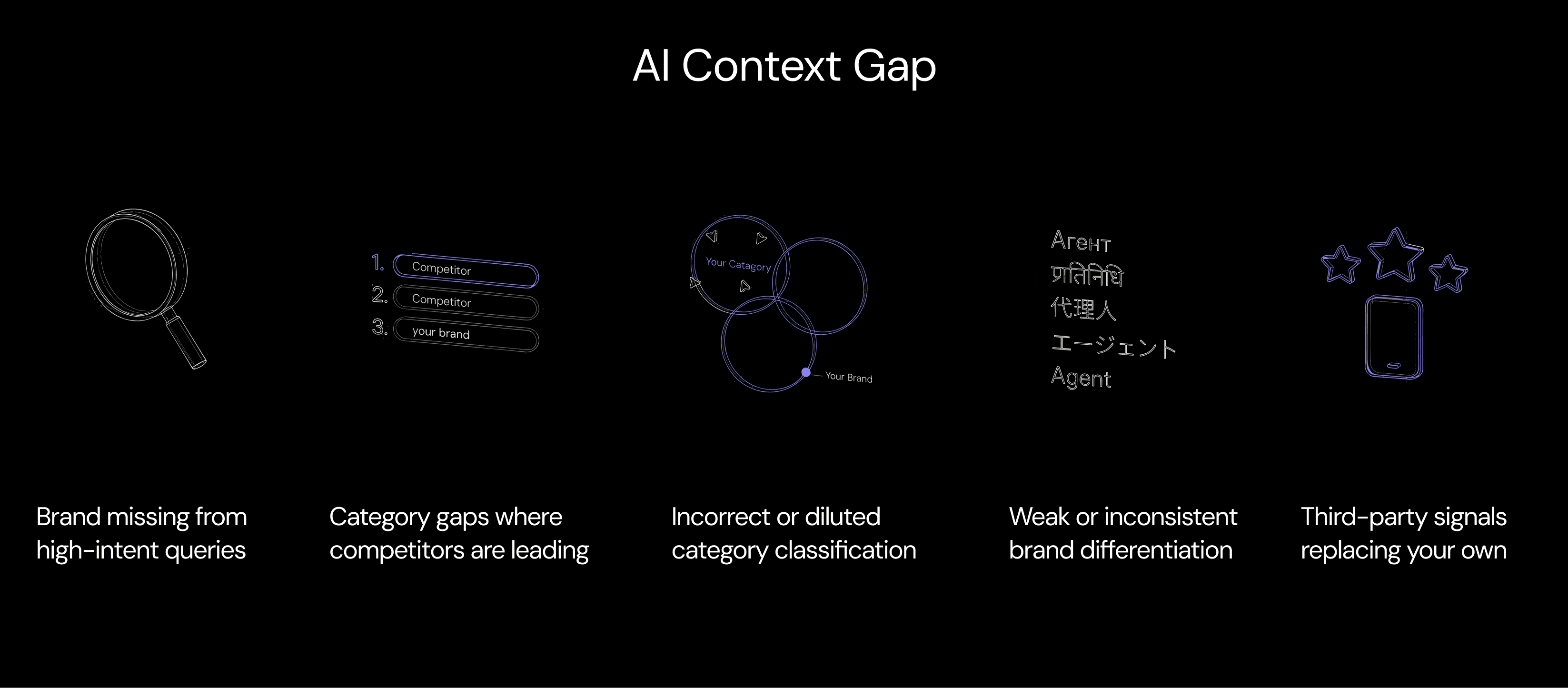
With outputs collected, the next step is to diagnose where interpretation breaks down, moving from observation to analysis by comparing your intended positioning with AI’s interpretation. These discrepancies often stem from how models gather and prioritize information through their AI assistant web search capabilities, which influence which sources are surfaced and how your brand is framed. You should identify patterns such as:
Your brand missing from high-intent queries where it should appear
Competitors dominating specific use cases you should own
Incorrect or diluted category classification
Weak or inconsistent differentiation language
Over-reliance on third-party descriptions instead of your own signals
If AI consistently misclassifies your category, it usually means your category signals are either unclear or inconsistent across pages. If competitors dominate recommendations, it often indicates they have stronger or more structured signals tied to those use cases.
4. Fix the Signals AI Actually Uses
Fixing the AI business context requires you to strengthen the specific signals AI relies on to interpret your business. That typically involves three layers:
1. On-site structure and clarity: Start with the pages AI is most likely to use as evidence, such as your homepage, product, category, or comparison pages. These pages need to define your category and positioning clearly enough for AI systems to extract. Tighten the headings, reinforce the positioning language, clarify the use-case copy, and ensure you state those key differentiators directly.
2. Content alignment across touchpoints: AI pulls from multiple sources, such as blogs, PR mentions, partner pages, review sites, and third-party references. Inconsistent messaging across those sources can distort how your business is understood. If your owned content says one thing and external sources say another, AI will blend those signals into a weaker version of your positioning, creating gaps that directly impact digital brand protection.
3. Reinforcement of differentiation and use cases: Your differentiation also needs to be reinforced consistently. If your strongest advantages are not clearly stated or are difficult to identify, they are unlikely to carry through into AI-generated answers. Strong, consistent associations between your brand and its key strengths make it easier for AI systems to classify and recommend it with confidence.
Most teams hit a wall here because they lack visibility into which fixes actually matter. Limy’s agentic marketing stack tracks real agent behavior - how AI systems access your site, interpret your content, and represent your brand inside answers. That gives teams direct visibility into how their business is being interpreted in real decision scenarios, rather than relying on assumptions or simulated prompts.
From there, it moves into execution. The platform identifies the changes that improve how your business is understood, then implements them to clarify your positioning and make it easier for agents to process.
5. Track Whether Context Improvements Change Outcomes
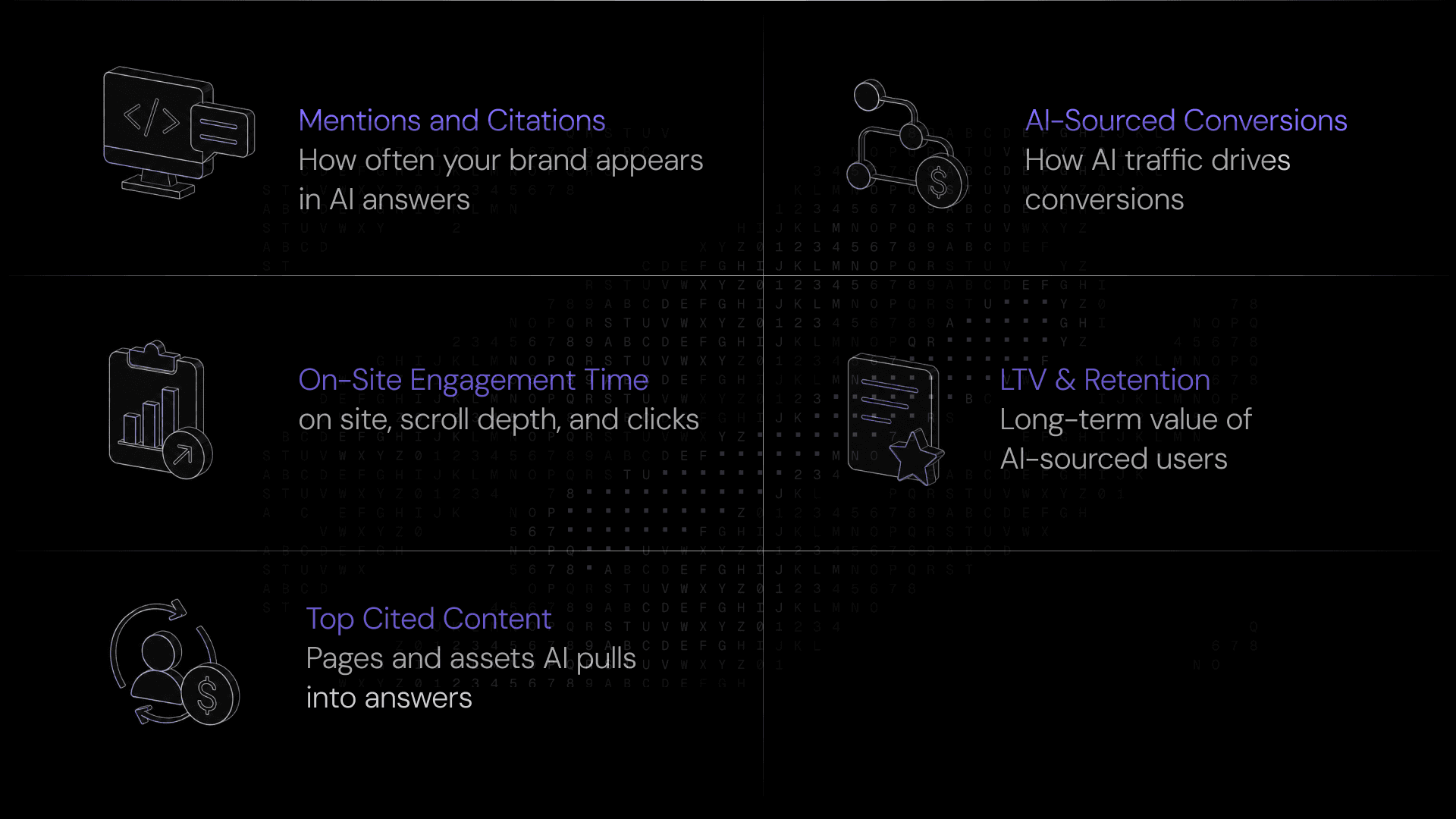
The step most teams miss is measuring whether your fixes actually change how AI behaves. Re-evaluate the same prompt set over time and tracking:
Changes in recommendation frequency
Improvements in positioning within answers
Shifts in competitor presence
Downstream impact on traffic and conversions
AI systems are constantly evolving, which means your context is not static. It needs to be monitored and refined continuously, based on how recommendations change over time. Limy closes this loop by connecting context changes directly to revenue outcomes. It tracks the full path from prompt to recommendation to interaction to conversion, using real agent behavior data rather than inferred signals.
The platform lets you see not just whether your visibility improved, but also whether your positioning led to stronger recommendations and whether those recommendations actually converted.
The Difference Between Being Seen and Being Chosen
The rules of visibility no longer determine the outcome. You can appear in AI-generated answers and still be excluded from the buying decision. The difference comes down to how your business is interpreted in the moment an agent evaluates options. If your category is unclear, your positioning is diluted, or your signals are weaker than a competitor’s, the system will move on, and you won’t see it. That’s why you need to define performance by whether AI systems can confidently understand and recommend your brand in high-intent scenarios.
Limy is the only marketing stack that turns AI search into a revenue channel. It operates at the infrastructure layer, capturing real agent behavior rather than relying on simulated prompts or surface-level visibility tracking. It shows which AI systems access your site, what they extract, and how your brand is positioned across LLMs, connecting that activity to prompt-level insights so you can see which AI-driven journeys actually lead to outcomes.
What makes this valuable is the ability to act on it. The platform identifies where your business context breaks and prioritizes those gaps based on revenue impact, then translates that insight into execution, suggesting how to improve content. Every change is measured against real outcomes, closing the loop from AI interaction to conversion.
Start now to see how AI systems are interpreting your brand, and where that interpretation is costing you revenue.
FAQs
Most Viewed Articles


