




Abstract
What Are Brand Mentions in AI Search?
Brand mentions in AI search refer to how often and in what context an AI-powered search engine or chatbot references a company, product, or brand when generating answers. Unlike traditional SEO rankings, AI brand mentions are influenced by factors like online authority, expert citations, content relevance, reviews, and how frequently a brand appears across trusted sources on the web.
Do you know which AI agents are mentioning your brand, and under what context? Buyers are landing on websites already educated, already comparing vendors, and often already leaning toward a decision. The research stage is increasingly happening elsewhere, in AI-generated answers that shape perception before a human user ever clicks a link.
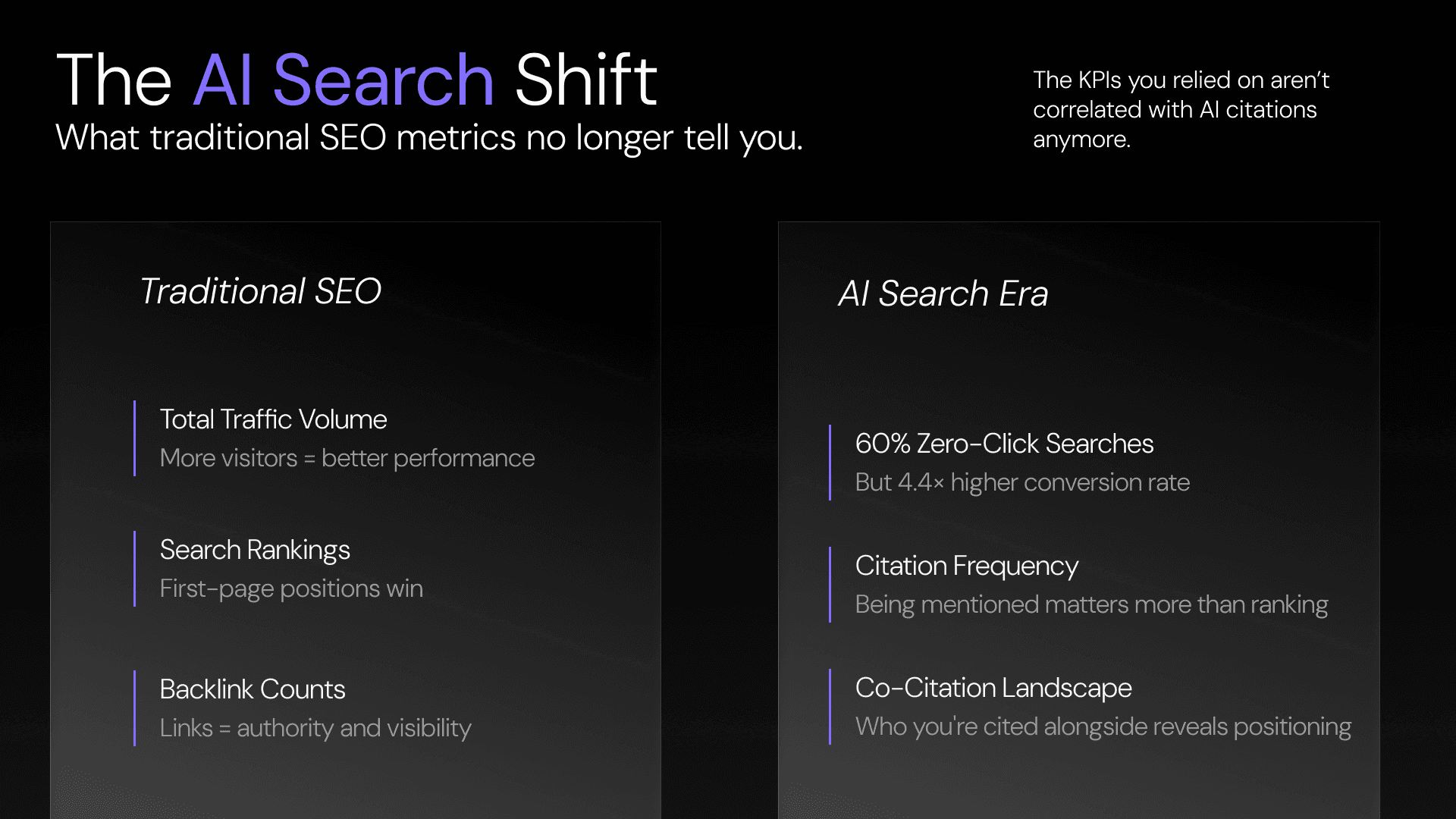
Despite AI agents already influencing product discovery, brand evaluation, comparison, and purchase consideration at scale, only 16% of Fortune 500 brands currently track AI search performance.
AI-generated answers do not distribute visibility evenly. They consistently reinforce a smaller set of brands, sources, and recommendations, making inclusion more important than ever.
Tracking brand mentions in AI search helps you understand where influence is happening. This knowledge is critical for evaluating your current gaps and moving forward with an improved strategy, ensuring a healthy, predictable pipeline and tying efforts to revenue growth.
What Are Brand Mentions in AI Search?
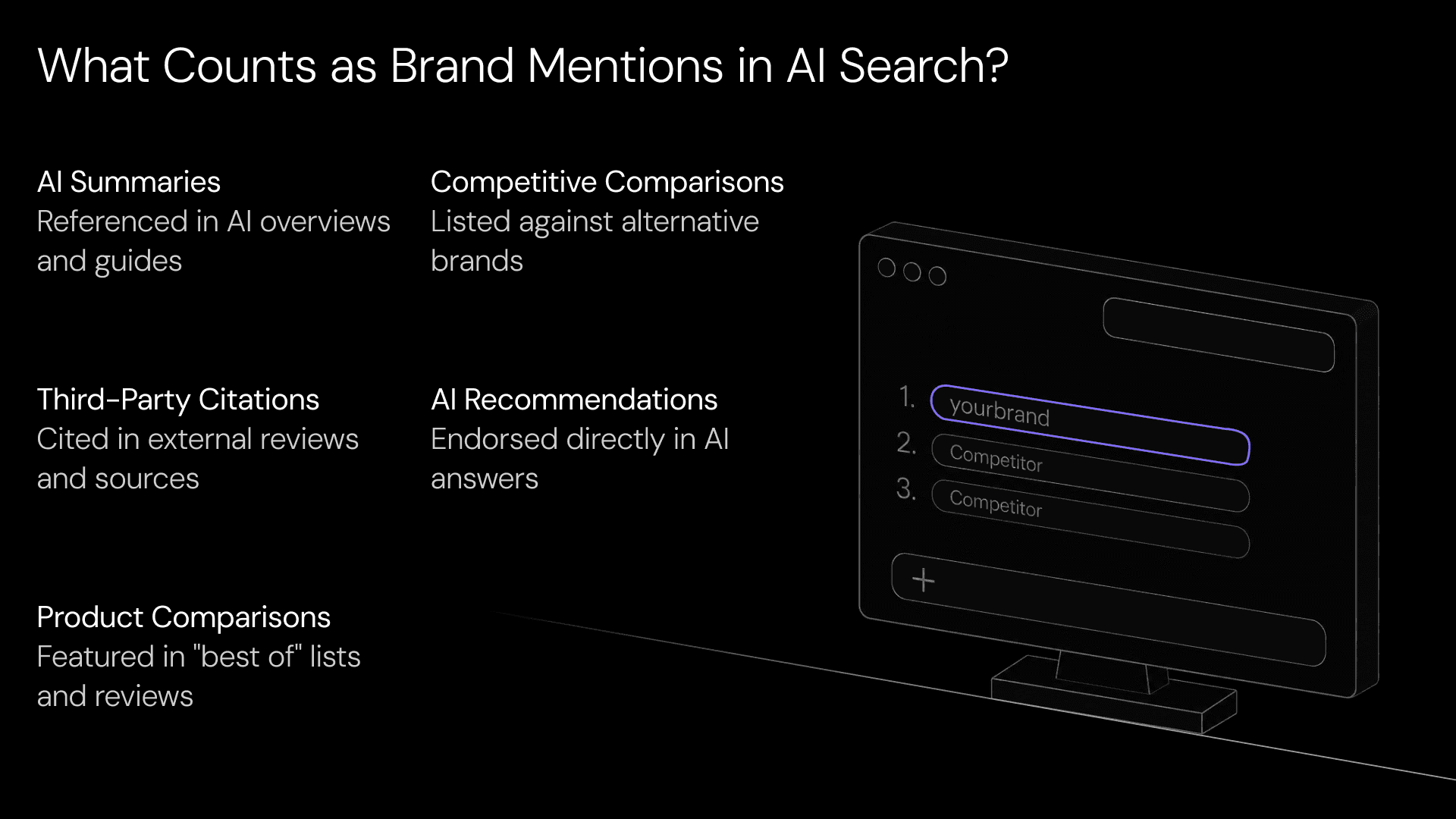
Brand mentions in AI search refer to situations in which AI agents reference, recommend, compare, or cite a company in agentic-generated responses. These mentions can appear across AI-powered experiences such as ChatGPT, Gemini, Claude, Perplexity, and Google Search’s AI Overviews.
Unlike traditional search engines, AI agents do not simply return a ranked list of links. They synthesize information from multiple sources and present a direct answer. In many cases, the answer already contains a shortlist of products, vendors, or recommendations before the user visits a website.
That changes the role of AI strategy visibility entirely. A mention inside an AI-generated answer functions more like a recommendation than a ranking. The system has already evaluated available information and selected which brands appear credible or relevant, thereby narrowing the decision set for the buyer.
Brand mentions are especially important for high-intent commercial queries. Prompts such as “best project management software for enterprise teams,” “top leak detection systems for hospitals,” or “best AI visibility platform for ecommerce brands” increasingly produce summarized recommendations rather than clickable search results.
In that environment, inclusion matters more than placement. If your brand doesn’t show up in the generated answer, you may never enter the buyer’s consideration set at all.
Why Are Brand Mentions in AI Search Important to Track?
Tracking AI brand mentions reveals far more than whether your company simply appears inside generated responses. It shows:
Whether your brand is included in high-intent recommendation queries
How AI agents interpret and frame your positioning
Which attributes and use cases are associated with your company
How frequently are competitors surfaced instead
Over time, these patterns reveal where you are winning or losing influence long before a buyer reaches your website. AI agents do not behave like traditional search engines, so you, as a user, won’t see a neutral list of ten blue links and be given responsibility for the evaluation process. Instead, AI models actively shape the shortlist, selecting which vendors they recommend for a specific use case and which products they exclude entirely. That means brand mentions are active recommendation signals embedded directly into the decision-making process.
Tracking also reveals how AI agents narrate your brand externally. In many cases, the issue is not a lack of visibility but poor positioning quality. Limy regularly sees brands with hundreds of mentions across AI agents while still suffering from negative sentiment, weak category association, or inaccurate framing. A company may appear frequently but still be described as outdated, secondary, overpriced, or misaligned with the exact use case it wants to own.
The cited sources behind those recommendations matter just as much. AI agents continuously reinforce information from the publications, reviews, comparison pages, and technical content they trust most. If those sources are inconsistent with your positioning strategy, buyers receive a completely different version of your brand story than the one your marketing team intended to communicate.
Over time, these recommendation patterns often compound. Brands repeatedly surfaced by AI agents gain familiarity, trust, and recommendation momentum, while brands excluded from high-intent prompts gradually disappear from consideration altogether.
Traditional Analytics | AI Search Tracking |
Captures clicks, sessions, and website visits | Captures prompts, recommendations, mentions, and AI-driven discovery |
Looks at human browsing behavior | Looks at agent behavior and AI-generated responses |
Measures post-click activity | Measures pre-click influence |
Controlled largely by search engines and attribution models | Controlled by AI agents, source relationships, and recommendation logic |
Misses the recommendation-stage influence entirely | Tracks how brands are surfaced before site visits happen |
Revenue attribution starts after the click | Revenue attribution begins at the prompt level |
8 Tips to Track Brand Mentions in AI Search
1. Start With Revenue-Critical Prompts
The prompts that matter most are decision-stage prompts tied directly to commercial intent and purchase behavior. These are the queries where AI agents often replace the traditional comparison journey entirely. Examples include:
“Best AI visibility tools for ecommerce brands”
“Top alternatives to [competitor]”
“[Brand A] vs [Brand B]”
The same behavior is happening across industries. In industrial automation, for example, buyers may search for the best smart manufacturing solutions long before they book a demo or visit a vendor website directly.
Teams should build a focused prompt library around comparison queries, pricing searches, alternative prompts, and industry-specific recommendation terms. Of course, doing this manually at scale is unfeasible, so you need a platform that supports all major AI engines and can monitor and extract insights from them.
2. Treat AI Mentions as Pre-Click Attribution Signals
A mention inside AI search is influencing events before attribution systems can properly detect them. By the time a user reaches your website, the recommendation may already have been included in an AI-generated answer. Buyers increasingly arrive with vendors already shortlisted.
Treat AI mentions as assistive marketing attribution signals rather than top-of-funnel impressions. Teams should monitor direct traffic increases, branded search growth, shortened conversion paths, and landing-page concentration patterns alongside AI visibility trends. Most analytics platforms cannot connect those signals effectively because they were built for human browsing behavior rather than AI-mediated discovery.
3. Track the Full Journey
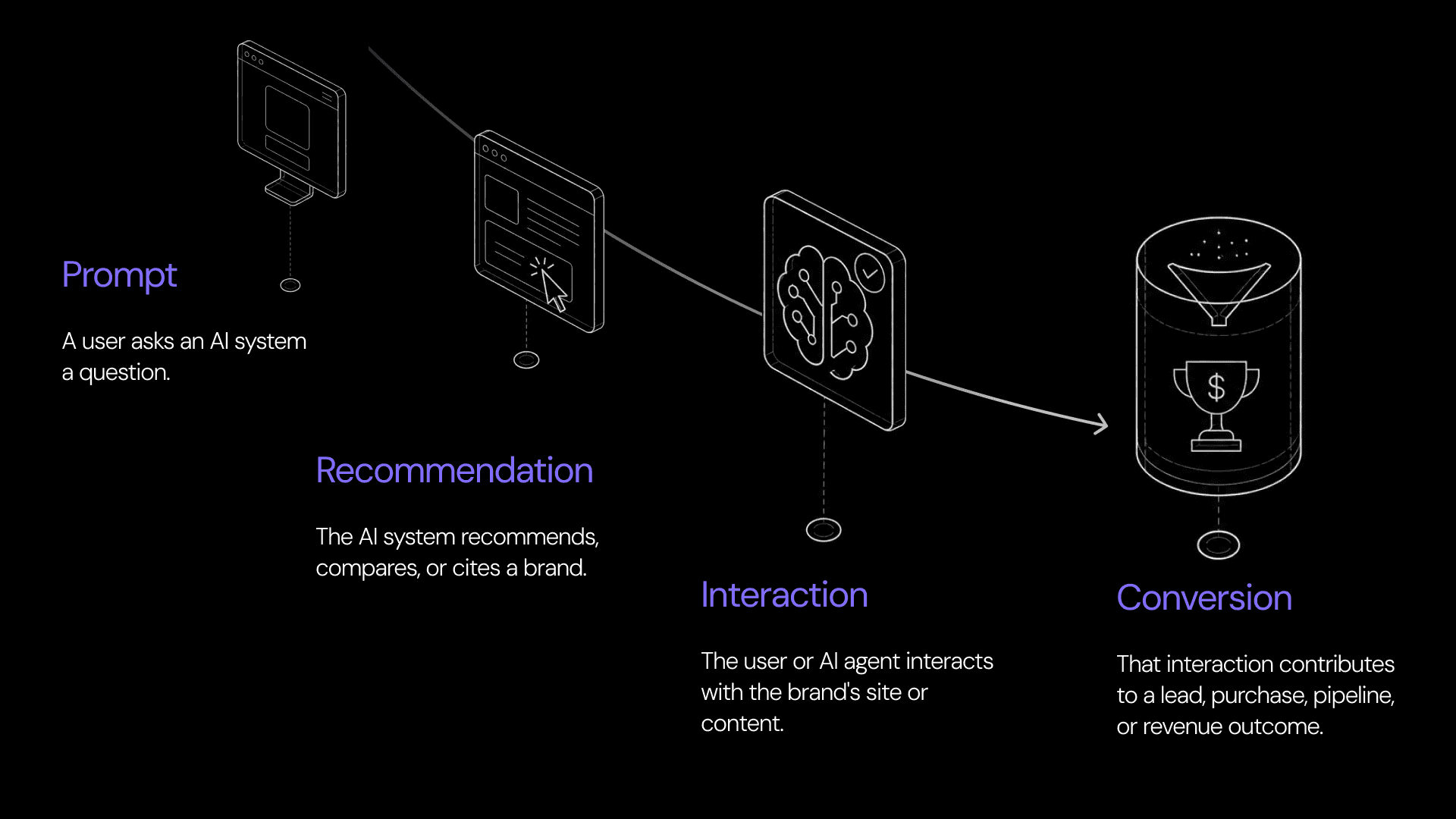
To understand how AI search actually influences revenue, teams need visibility into the full sequence from discovery to conversion, including:
Which prompt triggered the recommendation
Which recommendation generated interaction
Which interaction contributed to conversion
Which conversions generated revenue
GA4 and Search Console can show what happens after the click, but they don’t capture which prompt produced which recommendation that led to a visit, so they can’t attribute revenue at the prompt/recommendation level without an additional attribution layer.
4. Identify Where You’re Losing Influence
Most companies focus on where they appear, but the more valuable question is where competitors consistently replace them. AI search tracking should expose:
Prompts where competitors dominate recommendations
Categories where your brand is absent
Comparison queries where visibility gaps overlap with commercial demand
Teams should identify lost influence before it shows up in pipeline performance. To understand lost influence, you need an automated AI visibility tool that can continuously review your recommendation frequency, prompt-level inclusion rates, competitor share of mentions, and cross-LLM visibility.
5. Analyze How Agents Position You Versus Competitors
AI agents do not simply mention brands; they frame them. Teams should regularly audit AI-generated answers for commercially important prompts and compare how their brand is described against competitors. The goal is to identify recurring positioning patterns across recommendation responses.
For example, AI agents may consistently describe one company as “enterprise-grade” or “market-leading,” while framing another as “affordable,” “basic,” or better suited to smaller teams. Over time, these repeated descriptions shape buyer perception before a user ever visits a website.
Make sure your chosen AI visibility platform can track recommendation summaries, sentiment, competitor comparisons, and citation patterns across prompts and platforms. Otherwise, manual monitoring of positioning drift becomes almost impossible at scale.
6. Measure AI-Influenced Conversions Separately
Last-click attribution misses AI influence almost entirely. A user may discover your company through ChatGPT, return later through direct traffic, and convert through branded search without generating a measurable AI referral. Teams, therefore, need a dedicated AI-influenced conversion lens focused on:
AI-influenced sessions
Shortened conversion paths
Landing pages associated with AI referrals
Revenue trends linked to AI recommendation visibility
The goal is to understand how AI-driven discovery influences pipeline quality and conversion efficiency, thereby affecting revenue.
7. Build a System That Connects Insight to Revenue
Most teams can already see fragments of AI visibility. They notice competitors appearing more often in recommendation prompts, or they see branded traffic increasing without a clear acquisition source. The problem is turning those signals into a system that continuously improves performance.
You should monitor commercially important prompts across multiple AI agents and identify where competitors consistently outrank or replace your brand in high-intent recommendations. From there, you need to understand why those gaps exist. Sometimes the issue is weak positioning. In other cases, AI agents rely on outdated citations and competitor-controlled comparison pages.
Improving visibility often requires heavy content changes. For example, you may need to refine page positioning, improve structured data, strengthen external coverage, or publish clearer comparison content. This continuous and ever-growing workload can be incredibly challenging to operationalize.
Limy is the only marketing stack that closes that gap. It connects real agent behavior to a continuous loop of insight, execution, and revenue, helping teams identify high-impact opportunities, improve recommendation performance, and measure the commercial impact over time.
Brand Mentions in AI Search: What Do Good Results Look Like?
Inclusion Rate on Decision-Stage Prompts
This metric measures how often your company appears inside high-intent prompts tied to evaluation and buying behavior, particularly prompts containing terms like:
best
top
alternatives
vs
pricing
recommended
Good performance means consistently surfacing across the prompts most likely to influence vendor selection. If your competitors appear in “best” or “top” recommendation prompts while your brand only surfaces in informational queries, you are losing influence.
Recommendation Consistency Across Prompt Variations
AI agents often generate different answers to prompts that reflect the same buying intent but use different wording. For example:
“Best drone swarm defense systems”
“Leading AI software for drone swarm operations”
“Best multi-drone command and control solutions”
These prompts all point to the same underlying commercial need, but AI agents may still surface different recommendation sets depending on wording, source associations, and category interpretation. Your brand should consistently appear across multiple variations of the same buying-stage query.
Recommendation Positioning Quality
This metric measures how AI agents describe your company when recommending it. Strong performance means AI consistently associates your brand with:
the correct category
the right customer type
your strongest differentiators
commercially valuable use cases
Weak performance often manifests as vague positioning, outdated descriptions, low-authority framing, or repeated comparisons that position competitors as leaders.
Citation Quality and Source Control
This metric measures whether the publications, reviews, comparison pages, and third-party citations influencing AI-generated answers align with how you want the brand positioned. Strong performance here means AI systems consistently rely on authoritative, accurate sources when recommending your company, helping you protect your brand and messaging.
Cross-LLM Recommendation Coverage
Brands often perform well in one AI system while remaining almost invisible in others. This metric measures whether your company maintains recommendation visibility consistently across multiple AI models and agents. Your recommendation coverage should remain stable across multiple AI agents rather than depending heavily on a single platform.
Share of Recommendations
The metric measures how frequently your company appears relative to competitors across a tracked set of commercially important prompts. A strong result means your brand earns a meaningful share of total recommendations across high-intent categories, comparison prompts, and alternative queries.
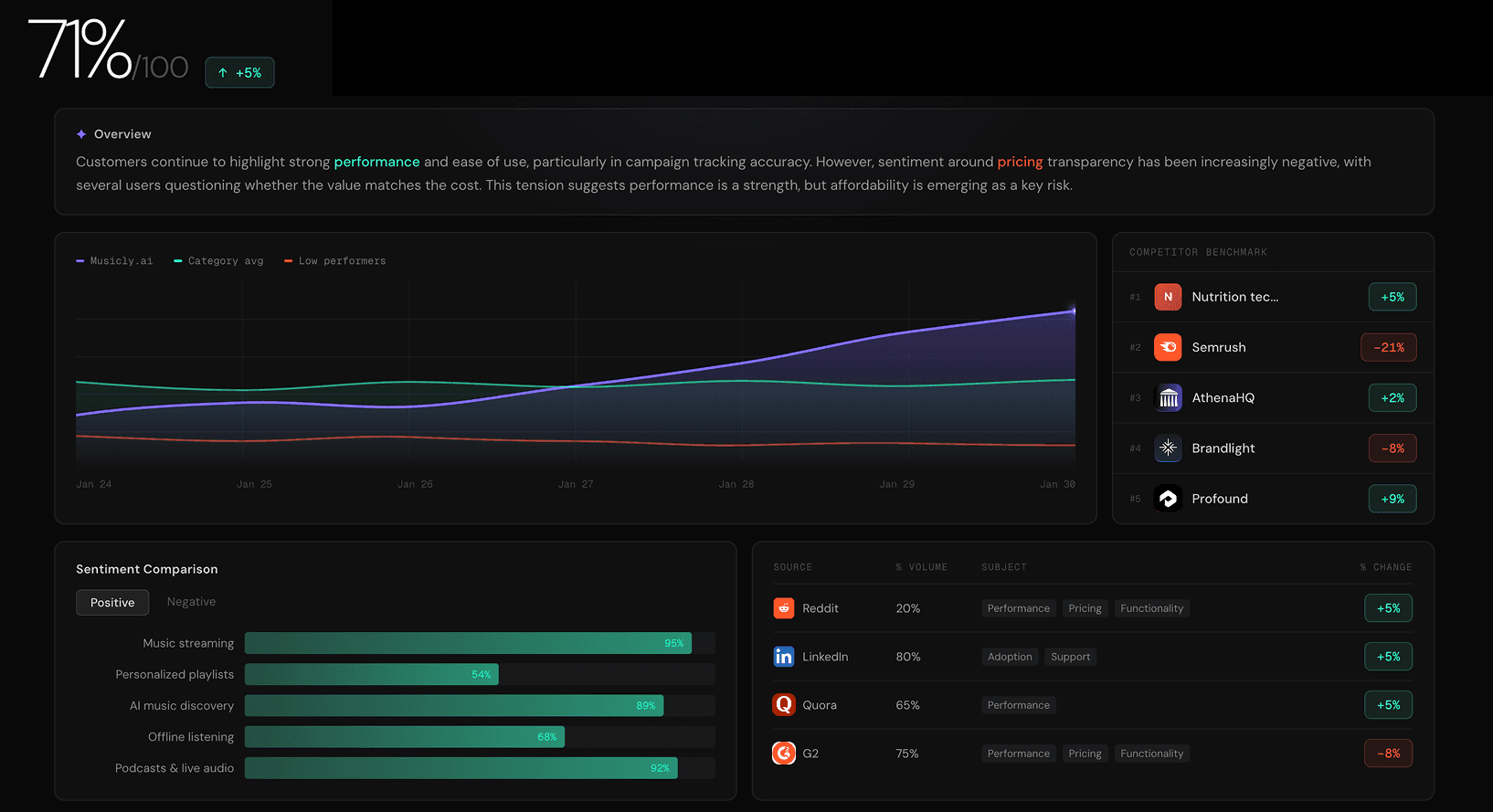
Limy tracks all of these signals, but more importantly, it connects them. Instead of reporting on mentions alone, it shows which prompts drive visibility, which recommendations lead to interaction, and which interactions convert, turning AI brand tracking into a measurable revenue channel.
What You Need To Track The New Layer of Influence
AI-generated answers increasingly shape discovery, and brand mentions now determine which companies enter consideration. Tracking brand mentions in AI search is a necessary starting point, but it is not the end goal.
Mentions don’t explain how decisions are shaped, how they prompt influence among buyers, or what those interactions contribute to revenue. To operate effectively in the agentic web, teams need visibility into the discovery and recommendation process.
Limy is the only agentic marketing stack that connects AI search visibility directly to revenue. Its Visibility and Prompt Analytics feature tracks recommendation frequency, competitor positioning, and cross-LLM visibility across multiple AI agents.
Meanwhile, this platform also shows how agents interact with your site and which prompts trigger that activity. Lastly, you can view the full path from prompt to recommendation to conversion, and get automated recommendations to improve AI visibility. Instead of stopping at visibility reporting, Limy helps teams understand how AI search influences pipeline and revenue, turning AI visibility into a measurable growth channel.
Ready to see how your brand actually performs inside AI search? Start now.
FAQs
How much does it cost to track brand mentions in AI search?
You can start free by checking ChatGPT, Gemini, Claude, and Perplexity by hand, but that does not scale, so most teams use a platform. The real question is return: knowing where you appear protects pipeline you would otherwise lose without noticing.
What is the step-by-step process to set up AI brand mention monitoring?
Build a prompt library around your decision-stage queries, track them across the major AI engines, see how you are framed and who shows up instead, then connect it to what happens on your site.
Which tools can I use to monitor my brand mentions across ChatGPT and other AI engines?
Prompting each engine by hand is free but hard to sustain, and GA4 only shows what happens after the click. A dedicated AI visibility platform tracks mentions, sentiment, and cross-LLM visibility in one place. Limy goes further and connects that to revenue.
How do I create a prompt library for tracking competitor mentions in AI search?
Build it around commercial intent, not brand terms: "best [category] for [use case]," "top alternatives to [competitor]," "[Brand A] vs [Brand B]." Add variations of each, then track how often competitors appear in place of you.
How often should I check for brand mentions in AI search engines like Perplexity and Claude?
Continuously, not once a quarter. AI answers shift as sources and models update, so a platform that refreshes automatically lets you watch trends instead of snapshots.
What should I do if I find negative mentions of my brand in AI-generated answers?
Often the problem is positioning, not absence. Trace the answer back to its sources, then fix your content so those sources describe you the way you want.
Most Viewed Articles


