




Abstract: AI search performance measures how effectively your brand appears, gets recommended, and drives business results across AI-powered search experiences. For marketing leaders, it matters because traditional analytics cannot fully measure AI-driven discovery. This article explains which metrics to track, how to measure them, and how to connect AI search activity to revenue.
This guide covers four steps for tracking AI search performance:
Configure a Prompt Set Around Revenue-Critical Topics
Monitor Brand Visibility and Competitive Position
Connect AI Search Activity to Traffic and Revenue
Prioritize Optimization Based on Revenue Impact
The first wave of AI visibility tools made mentions, share of voice, citation counts, and visibility scores the default KPI. That made sense when brands were simply trying to understand whether AI systems knew they existed. But a mention does not tell you whether AI recommended your brand, influenced a buying decision, generated a visit, or drove revenue.
Generative AI traffic to retail websites increased 4,700% year-over-year, highlighting how quickly AI-assisted discovery is becoming a meaningful acquisition channel. Yet most AI search measurement frameworks stop at visibility, treating AI search performance as an SEO reporting exercise and only measuring fragments of the journey.
What Is AI Search Performance?
AI search performance measures how effectively your brand is discovered, recommended, engaged with, and converted through AI-powered experiences such as ChatGPT, Gemini, Claude, Perplexity, and AI Overviews.
Unlike traditional search, AI systems do not simply return a ranked list of links. They evaluate information, compare alternatives, synthesize recommendations, and often narrow a buyer's consideration set before a website visit ever occurs. By the time a prospect reaches your site, AI may have already influenced which vendors they evaluate and which products they trust.
This new search trend changes what marketers need to measure. Traditional SEO performance focuses on rankings, impressions, and clicks. AI search performance focuses on recommendations, influence, engagement, and commercial outcomes. The goal is no longer simply to appear in search results, but to become one of the brands AI systems recommend when buyers ask commercially relevant questions.
To accurately understand performance, marketers need strategic visibility across the entire AI search journey. That means measuring discovery, recommendations, interactions, and conversions rather than focusing on isolated touchpoints.
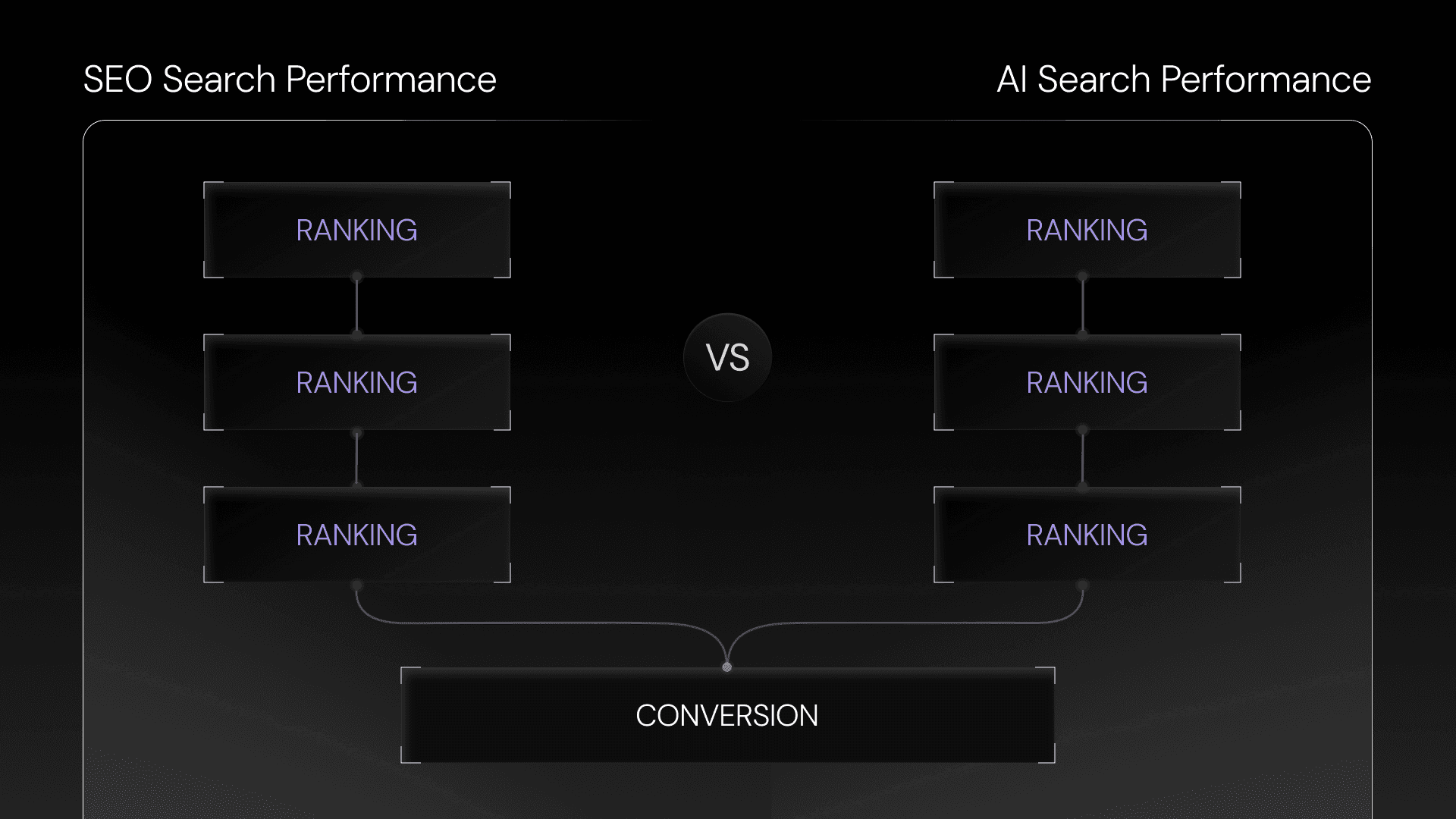

The Blind Spots in AI Search Performance
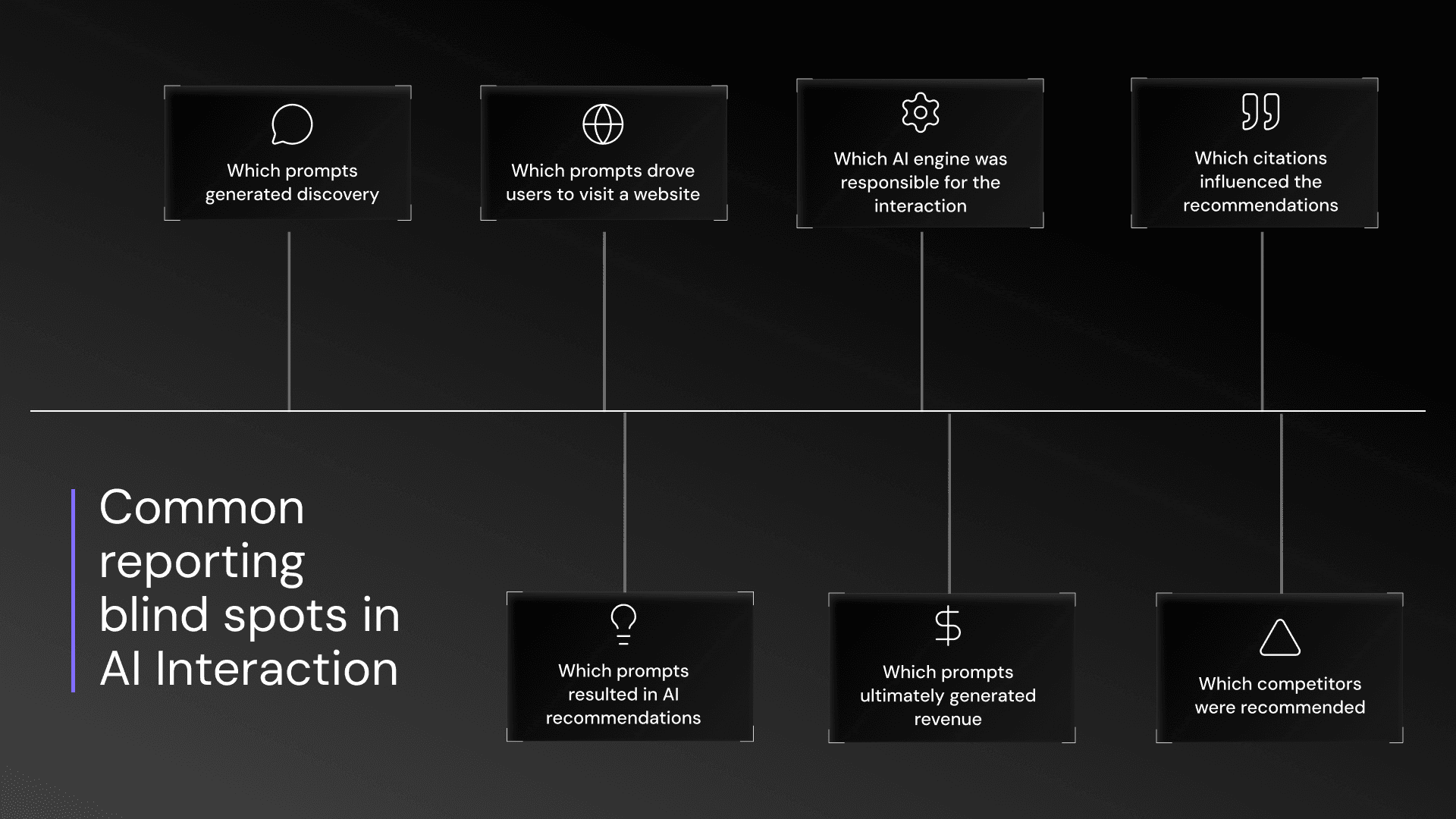
Most analytics platforms were built for human search behavior. Tools like Google Analytics, Search Console, and even SEO APIs can show parts of the journey, such as traffic sources, queries, clicks, and on-site behavior. But they still do not connect AI exposure to the full path from prompt to recommendation, session, conversion, and revenue. As a result, teams may see fragments of AI-driven activity without understanding which prompts, answers, or recommendations influenced business outcomes.
Many AI visibility platforms create a second blind spot. They monitor AI outputs or simulate prompts to estimate visibility. While useful, those approaches cannot explain how AI engines, crawlers, bots, and agents discover, evaluate, or interact with your content.
Measuring how AI systems access, extract, and use content is fundamentally different from measuring what users type.
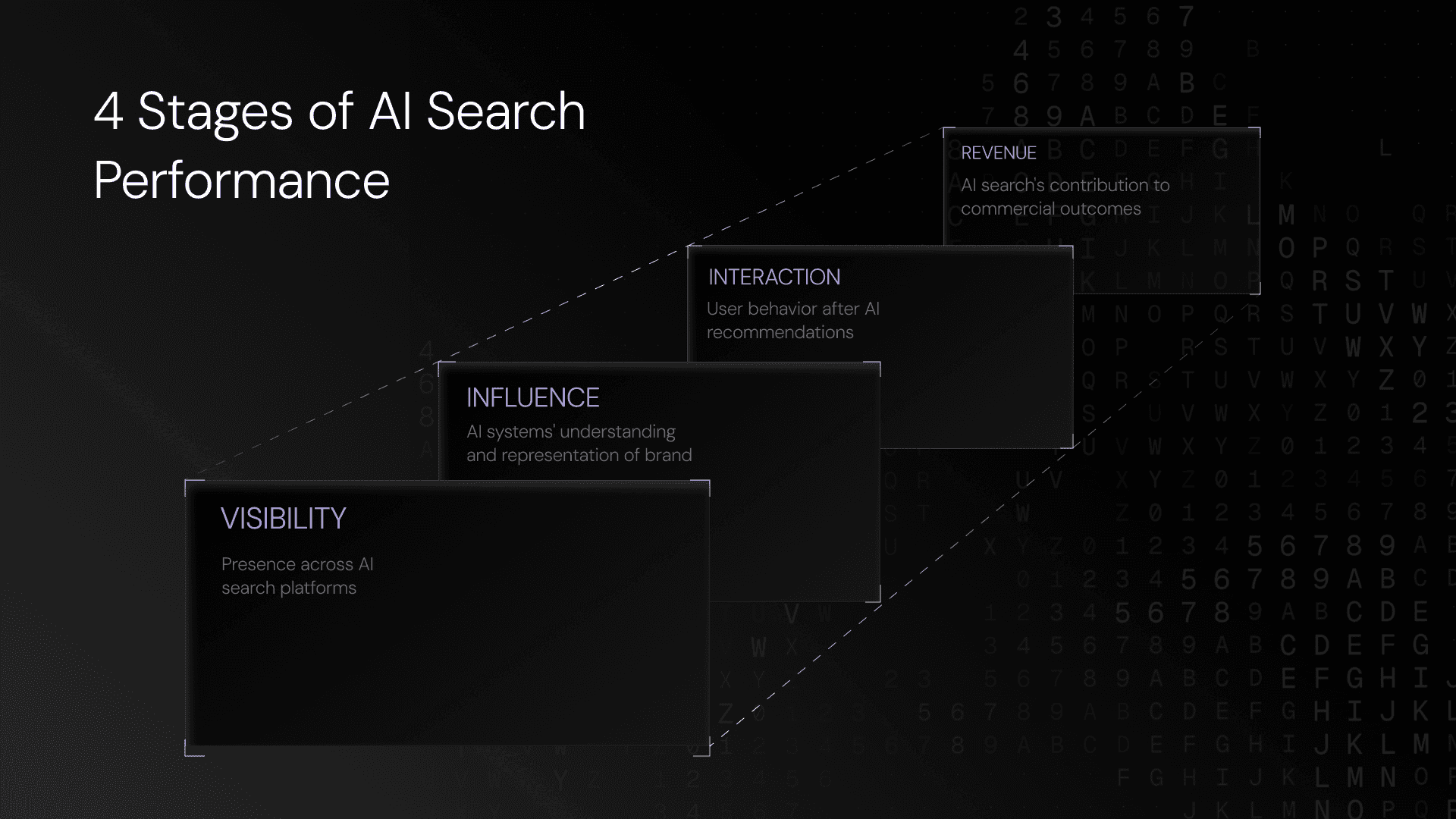
4 Layers of AI Search Performance Every Team Should Track
Layer 1: Visibility
Before you can measure engagement or revenue, you need to understand whether your company appears when users ask questions related to your category, product, competitors, or use cases.
This layer focuses on your overall presence across AI search. That includes looking at recommendation frequency, prompt coverage, share of model, cross-LLM performance, and competitor inclusion gaps.
Visibility is important because it determines whether you're part of the conversation. However, appearing in an answer does not automatically mean AI systems view your brand favorably, nor does it guarantee engagement or commercial impact.
It's also important to reduce noise. Measuring every possible prompt often yields impressive-looking visibility numbers with little commercial value. Visibility tracking should focus on prompts connected to product discovery, category evaluation, and purchase intent.
Layer 2: Influence
Influence tells you how AI systems understand and represent your brand. AI platforms do not simply mention companies. They describe them, compare them, categorize them, and explain why they may or may not be relevant to a user's question. As a result, two brands can have similar visibility levels while being positioned very differently.
This layer focuses on the quality of your presence within AI-generated answers:
Are AI systems describing your company accurately?
Are they associating you with the right category, audience, and use cases?
Which sources are shaping those recommendations?
How do you compare against competitors when buyers ask evaluation-stage questions?
Looking at citation share, positioning accuracy, sentiment, category placement, and competitive comparisons helps teams assess whether AI systems represent the brand as intended. These insights are also increasingly important for brand protection, expanding the concept beyond trademark abuse, impersonation, and counterfeit risk into how AI systems describe, classify, and compare the brand before buyers reach the site.
Layer 3: Interaction
The next layer focuses on what happens after a recommendation influences user behavior. Teams should understand how much AI referral traffic they're receiving, which platforms drive the highest-quality visits, how users engage with landing pages, and whether agent-triggered visits are increasing over time. This layer helps distinguish between recommendations that generate awareness and recommendations that generate meaningful interest.
Layer 4: Revenue
Ultimately, AI search should be measured as a growth channel, not a visibility channel. While appearances, recommendations, and engagement all matter, they are only valuable if they contribute to commercial outcomes. This layer connects AI search activity to leads, opportunities, pipeline, purchases, and revenue. It helps teams understand which prompts influence conversions, which recommendation paths generate the highest-value customers, and where optimization efforts create the greatest return.
Revenue attribution and prompt-to-conversion analysis are particularly important because they reveal which AI search activities create measurable business value.
Layer | Main Question | Example Metrics |
Visibility | Are we appearing? | Coverage, Recommendation Frequency, Share of Model |
Influence | How are we being perceived? | Citation Share, Sentiment, Positioning Accuracy |
Interaction | Are recommendations generating engagement? | AI Sessions, CTR, Engagement |
Revenue | Are recommendations generating business outcomes? | Leads, Pipeline, Revenue Attribution |
AI Search Metrics Glossary
Inclusion Rate: The percentage of tracked prompts where your brand appears. Inclusion Rate provides a baseline visibility measure and helps teams understand whether AI systems recognize their brand as relevant within specific topics or categories.
Recommendation Frequency: Measures how often your brand is actively recommended rather than simply referenced. Recommendation Frequency is generally more valuable than Inclusion Rate because recommendations have a greater influence on buyer decision-making.
Citation Share: The percentage of citations and referenced sources associated with your brand compared to competitors. Citation Share helps explain why some brands receive stronger recommendation coverage than others.
Share of Model: Your share of recommendations across a defined prompt universe. Similar to market share, Share of Model provides a competitive benchmark for AI search visibility.
AI-Assisted Sessions: Sessions where AI systems influenced the discovery path, whether through direct click-throughs, citations, recommendations, or AI-assisted research behavior.
Prompt-to-Conversion Rate: The percentage of conversions attributable to a specific prompt or recommendation path. This metric helps identify which AI-driven journeys generate the greatest business impact.
How to Correctly Track AI Search Performance
Configure a Prompt Set Around Revenue-Critical Topics
Build a prompt universe around commercial intent, including product discovery searches, category-level queries, competitor comparisons, evaluation-stage questions, and purchase-intent prompts. From there, teams can expand coverage using prompt discovery tools, competitor analysis, and AI search monitoring platforms that surface related queries and emerging prompt patterns.
You don’t need to track every possible prompt, but you should build a representative set of the conversations most likely to influence discovery, evaluation, and purchase decisions. Once established, this prompt set becomes the foundation for measuring visibility, recommendations, competitive performance, engagement, and revenue impact over time.
Most AI search tools tell you whether your brand appeared in an answer. The limitation is that AI visibility alone does not explain why performance changes or which prompts actually influence business outcomes. Operating at the infrastructure layer, Limy tracks how AI agents discover, access, and interact with your site.
Rather than simply showing where a brand appears, it shows you exactly which prompts, sources, and agent activity are driving AI search performance so you can understand how AI systems are actually discovering and evaluating your brand.
Step 2: Monitor Brand Visibility and Competitive Position
Run those prompts across the AI platforms you're tracking and record which brands appear, how frequently they're recommended, which sources are cited, and how responses change over time. This baseline should include both your brand and key competitors. In many cases, the most valuable insights come from prompts in which competitors are consistently recommended, and your brand is absent. These gaps often reveal opportunities to improve content, strengthen authority around specific topics, or address positioning issues that prevent AI systems from recommending you.
If a competitor appears more frequently, the next question is why.
Are they being supported by stronger citation sources?
Is AI describing them more clearly?
Are they more strongly associated with a particular category or use case?
It's also important to remember that AI-generated responses are not always identical. Model differences, prompt wording, source availability, and user context can all affect which brands are recommended and how they are described.
Step 3: Connect AI Search Activity to Traffic and Revenue
The next step is understanding which AI recommendations generate visits. Ideally, you track AI referral traffic, AI-assisted sessions, landing pages receiving AI traffic, and agent activity on-site. You can then connect them to leads, opportunities, pipeline, and revenue.
For ecommerce brands, that post-click journey is especially important. AI-assisted discovery may influence which product pages shoppers land on, how they evaluate recommendations, and how AI personalization shapes the path to purchase.
In reality, however, traditional analytics platforms weren’t designed to measure AI-driven discovery. They may identify some AI referral traffic, but they typically cannot show which prompts influenced the visit or which recommendation drove engagement.
Limy is built to track the complete journey from prompt to conversion. It connects AI discovery and recommendation data with engagement, conversion, and revenue signals, helping teams understand which AI-driven journeys create measurable business outcomes. Rather than treating AI search as a separate reporting silo, it allows organizations to evaluate AI search using the same commercial lens they apply to every other acquisition channel.
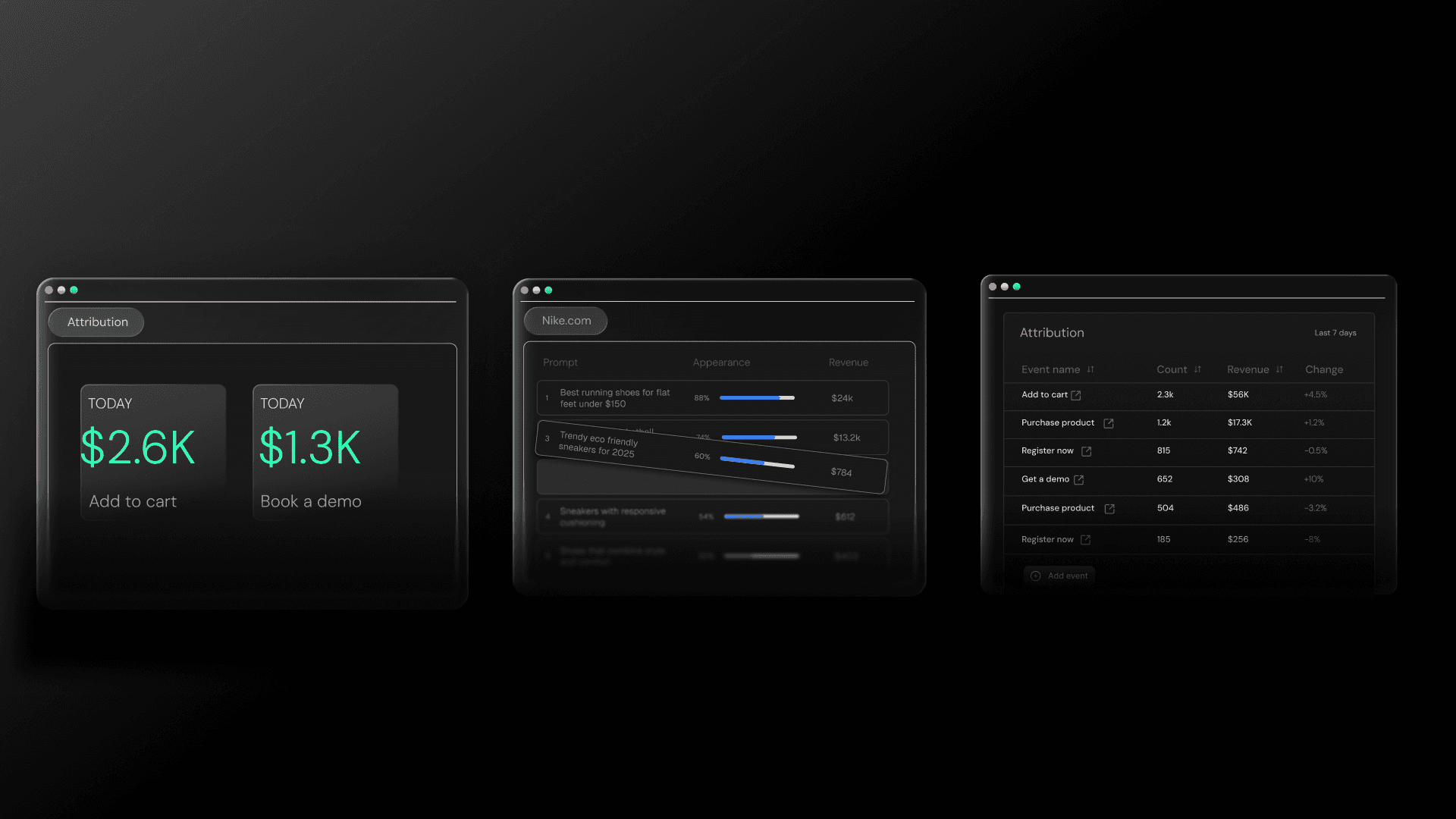
Step 4: Prioritize Optimization Based on Revenue Impact
Not all prompts carry equal value. Some prompts build awareness, others influence evaluation, and others affect purchasing decisions and revenue outcomes. Your team should focus on the areas with the highest commercial impact and evaluate:
Prompt categories driving revenue
Competitor recommendation gaps
Citation gaps
Content opportunities
Category positioning gaps
Recommendation opportunities
Limy's Recommendations Engine helps automate this process by identifying the highest-impact opportunities and prioritizing actions based on expected revenue outcomes. Instead of guessing which optimizations matter most, teams can focus on the changes most likely to improve recommendation performance and business results.
Stop Measuring AI Search Like Traditional Search
Visibility is useful, but it only explains whether you appear. As AI becomes a larger part of how products are discovered and selected, the organizations that gain an advantage will be those that measure the entire journey rather than isolated signals. The goal isn't to track mentions but to understand influence.
As a marketing stack for the agentic web, Limy gives teams visibility into how AI engines, crawlers, bots, and agents discover, evaluate, and recommend their brand, while connecting those activities to measurable business outcomes. Unlike visibility tools that focus on monitoring AI outputs, the platform operates at the infrastructure layer, tracking real agent behavior and helping teams understand which prompts, sources, recommendations, and interactions are actually driving growth. The result is a complete view of AI search performance, from first discovery to revenue impact.
Start now to see how Limy turns AI search from a black box into a measurable revenue channel.
FAQs
Can GA4 accurately track AI search traffic?
Only partially. GA4 can categorize some AI referral traffic, but it cannot show which prompt or recommendation drove the visit.
What is the difference between AI visibility and AI search performance?
Visibility is whether your brand appears in AI answers. Performance is whether those answers drive engagement, leads, and revenue. Visibility is just one part of it.
What are the most important AI search KPIs?
Recommendation Frequency, Share of Model, Citation Share, AI-Assisted Sessions, Prompt-to-Conversion Rate, and revenue attribution.
How do I measure AI search performance without a dedicated tool?
Run 20 to 50 commercial prompts across ChatGPT, Gemini, Perplexity, and Claude and log where you appear. It works as a start, but it cannot connect prompts to revenue.
What is Share of Model?
Your share of recommendations across a set of tracked prompts. Like market share, it shows how often you are recommended versus competitors.
Most Viewed Articles


